Skip to content

Equal opportunity for all

Whether acting as a visitor guide or lending a helping hand during lab courses for students: Steffen is a sought-after point of contact at experimenta – open, warm and with a special knack for connecting with people.

06.07.2026
Alexandra Wolters

S

A black or red polo shirt paired with a matching black zip-up jacket, both featuring the experimenta logo, is how visitors can recognize the staff at the science center in Heilbronn – and ask them all manner of questions: “Where can I find the big water world?” “What exactly do I need to do at this station?” The visitor services team is always happy to help.

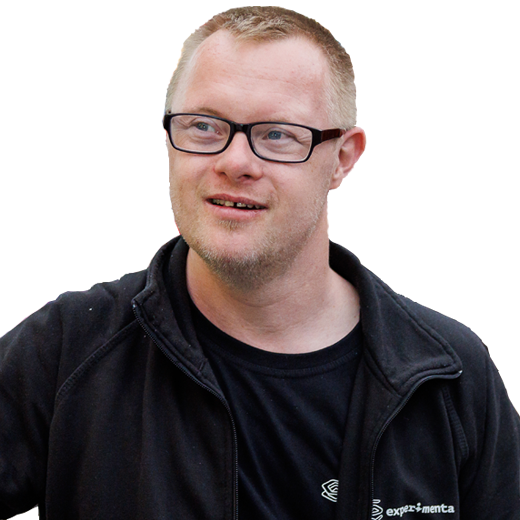
Part of this team is Steffen, who has been working at experimenta since January and has Down syndrome. Both adults and children usually notice his disability right away, but it just as quickly fades into the background. Because it is at experimenta that Steffen really comes into his own: he is just incredibly good with people. “I like talking to people, asking them what they particularly like or if they need help,” says the 39-year-old in describing part of his job.

To conduct his visitor surveys, he walks attentively through the five floors of the science center, stopping wherever a small line forms or if he encounters puzzled faces. “Can I print this picture out somewhere?” asks a boy who has just been editing his own photos on a computer. Steffen runs a hand thoughtfully through his reddish-blond hair before showing the fifth-grader where the printer is.

“Children, in particular, often approach him,” several colleagues say. With his inquisitive gaze, Steffen just comes across as very approachable and open. He also enjoys interacting with his coworkers: “Is it busy today?” he asks almost every morning at the counter. And if there is enough time, he wants to know how his colleague’s weekend was or if they watched the VfB Stuttgart game.

About Steffen

Steffen has been working at experimenta in Heilbronn since January and has Down syndrome. The 39-year-old conducts surveys within the exhibition and assists in leading various lab courses. He lives in an assisted living community and receives support from his family.

Ein Portraitbild von Steffen

From internship to dream job

Before joining experimenta, Steffen worked for 20 years in the joinery at “Lebenswerkstatt,” a facility in Heilbronn that assists people with disabilities. “There I built things such as wine crates and wooden Advent calendars,” Steffen says. He really enjoyed his time there, but eventually wanted to try something new. An internship at experimenta gave him the opportunity to gain new experiences in supported employment.

For Steffen, working at his own pace is important – just like the routines he has come to love, both at work and in everyday life. Steffen lives in Heilbronn in an assisted living community, where he receives support with tasks such as doing laundry, cleaning, shopping and cooking. “Yeah, doing the housework is a pain,” Steffen groans. Getting up in the morning, on the other hand, is easy for him. He always looks forward to going to work, which he does by bus every morning. He walks home in the afternoon after work. “Exercise is good for me,” says Steffen, grinning as he flexes his biceps. Three times a week, he works on his endurance and strength at the gym.

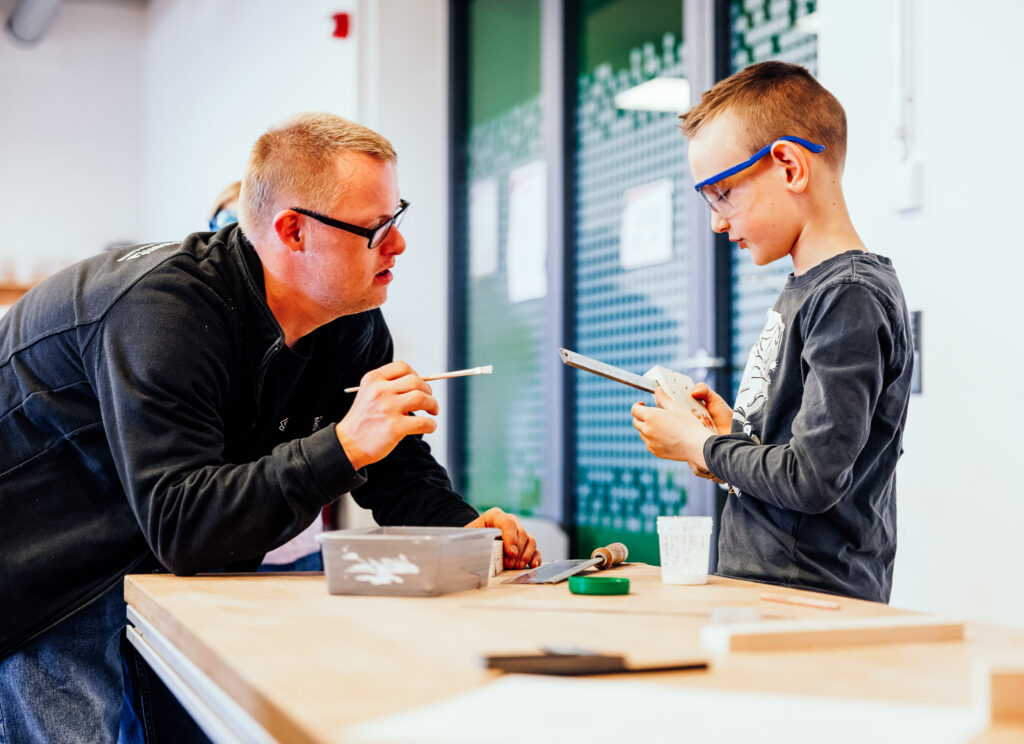
Ein Mann hilft einem Schüler in einem Kurs.
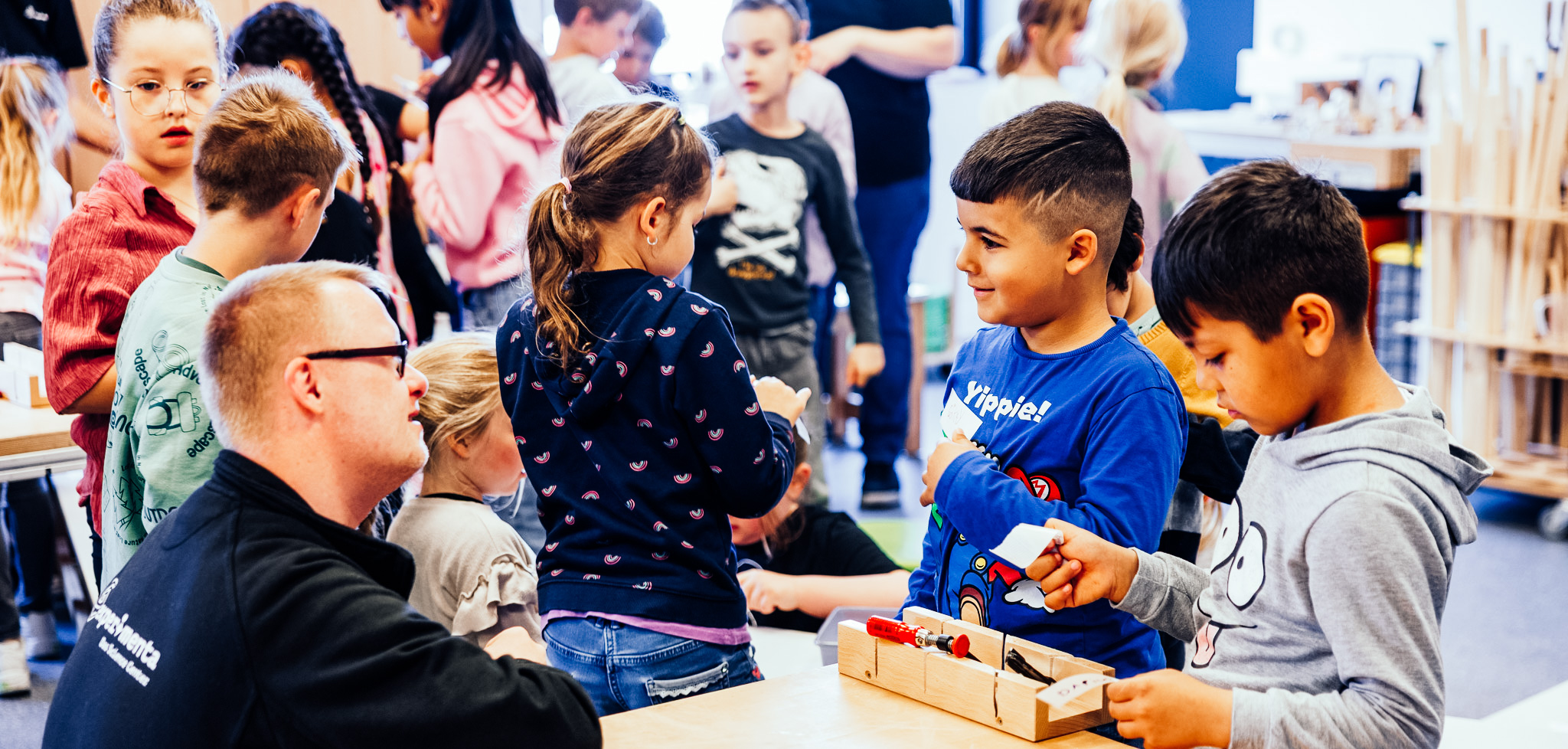
"Steffen is a woodworking pro," says eight-year-old Noel, who is attending experimenta's "Screwing, Sawing, Hammering? It's child's play!" course with his school class. Steffen supports the instructor by offering the children advice and assistance.
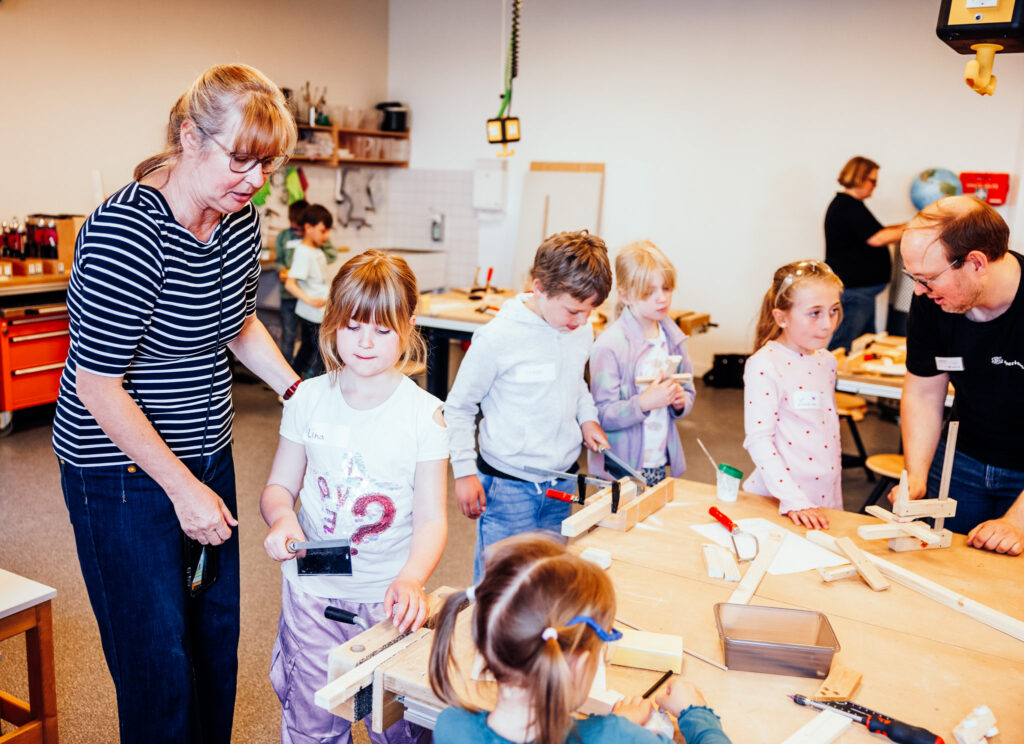
Eine Lehrerin und ihre Schüler*innen in einem Kursraum.
Teacher Heike Schmidt told the children about Steffen and Down syndrome beforehand. According to Schmidt, it is often easier for children to approach someone who shows such open and warm interest in them as Steffen does.
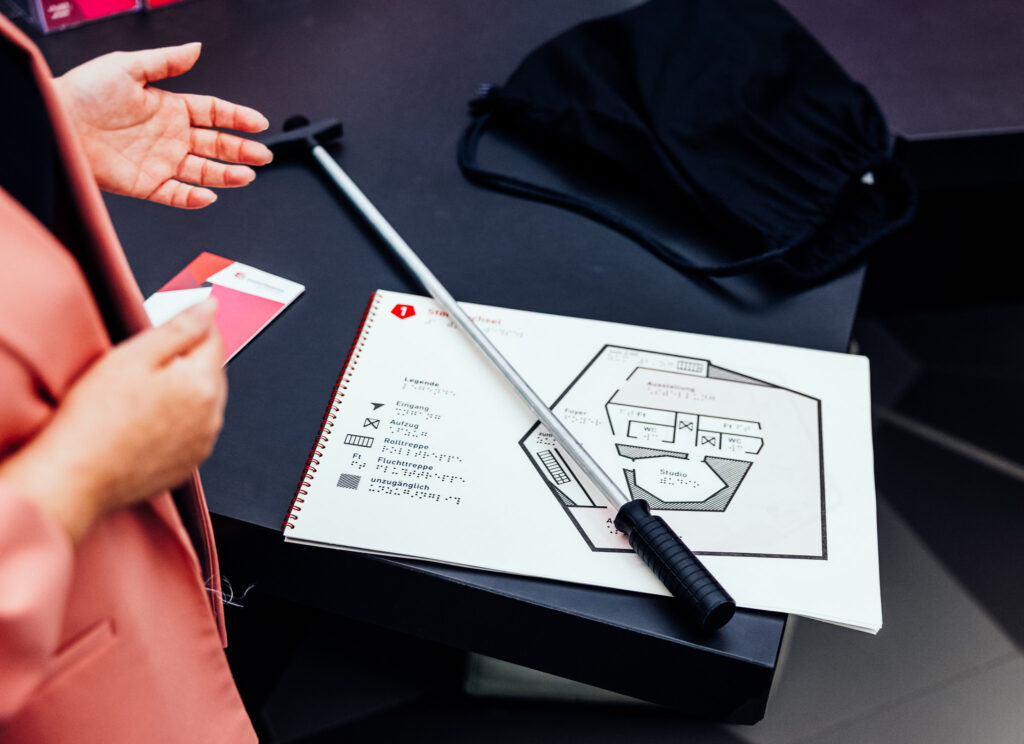
Ein Grundriss eines Gebäudes liegt auf einem Tisch.
experimenta is open to everyone and therefore offers programs specifically for people with disabilities. These include, among other things, information in Braille and tactile guidance systems – as well as courses for specific target groups.

A popular guide

That is why Steffen has no trouble giving his all in the various lab courses he assists with in the old building at experimenta, the former Hagenbucher warehouse. Today, 30 children from the Neudenau Elementary School are visiting. In the course “Screwing, Sawing, Hammering? It’s child’s play!” they learn how to use tools correctly and work with wood. After a brief introduction, they get started. First, the children sketch out their plans: cars, boats, robots and all kinds of airplanes are drawn on paper. “Anything goes, except weapons,” Steffen explains. “And the finished creation has to fit in your backpack.”

Steffen walks slowly through the rows between the workbenches. He doesn’t get very far. Over here, a girl tugs at his black shirt; over there, a boy holds out a drawing to him. “Can I build it like this?” “Which piece of wood should I use?” Whenever a question comes up, Steffen stops, bends down and explains to the children, at eye level, whether they should use screws or glue and where they can find the right materials.

Commitment and opportunities for everyone

experimenta aims to be open to everyone and to foster shared experiences. This also includes creating opportunities for people with disabilities. In the entrance area, there is a tactile model of the experimenta buildings, complete with Braille. This allows people with visual impairments, for example, to feel how the five floors of the new building wind their way upward. “This is important to make it clear that our escalators are located in different places on each floor,” explains Yvonne Bierbaum, the inclusion coordinator at experimenta. Tactile maps, tactile guidance systems and elements, as well as audio files, help people with visual impairments – and other visitors – find their way around, while also conveying important information.

experimenta also offers special programs for people on the autism spectrum: On the “Discovery Days”, the exhibition opens exclusively for registered groups, each with different support needs. During these regularly scheduled sessions, groups can visit the exhibition in a safe, protected environment and take plenty of time to explore the interactive stations, which are adapted as needed.

The “Quiet Hour” is designed for people who, for a variety of reasons, need a quieter environment and fewer sensory stimuli. Loud interactive elements are turned off, quiet areas are available and visitor numbers are limited.

The inclusion team at experimenta is constantly looking for ways to improve the exhibition. For example, an “arm extension” was recently created to allow people in wheelchairs or those of short stature to operate screens and large interactive elements. “For us, inclusion isn’t limited to just visiting experimenta,” explains Yvonne Bierbaum. “Steffen is a great example of how people with disabilities are successfully integrated into our work teams – and how we can learn from them.”
Taking pride in your own decisions

Noel jumps up and down with excitement as his airplane is inserted into the glue clamp for the final step. “Steffen is a woodworking pro. He helped me keep the saw blade perfectly straight and clamp the press really tight,” says the eight-year-old. His teacher, Heike Schmidt, had told the class a little about Down syndrome beforehand. “They were curious about Steffen, but here in the workshop they see him above all as an expert they can turn to for advice,” she says, describing the situation. For children, it is often easier to approach someone who shows such open and warm interest in them as Steffen does. And someone who does not always phrase every sentence perfectly – much like some of the children themselves, or those whose native language is not German.

Steffen listens patiently to all the questions and helps out wherever he can. At the same time, he ensures that everyone can gain their own experience. For example, he does not give any tips on exactly what they should build. “You can decide that all by yourselves.” That really matters to him, because he is incredibly proud that he can make many decisions independently. “I also decided to take the job here at experimenta on my own. And that was a good thing, because they need me here,” says Steffen, putting a few screwdrivers and files back in their proper places before he leaves for the day.

;