
“We’re trying to develop a kind of instruction manual for working with AI”
Menna El-Assady from ETH Zurich is working on approaches that promote mutual understanding between AI and humans. The aim is to ensure better interaction.
read more
In Heilbronn, a digital twin is being tested to make the water network more efficient and secure. This saves resources and costs – and opens up new business models for companies.
In January 2025, a broad flood made its way along the B27 in Heilbronn, replacing the usual stream of cars with a raging torrent of water. The cause was a six-meter-long crack in a dilapidated water pipe from the 1980s, located directly under the roadway. “Most leaks in the pipe system are silent,” says Frank Schupp, managing director of Heilbronner Versorgungs GmbH (HNVG). “This means that they initially don’t cause any visible damage, and the water simply seeps into the ground. In many cases, they are only noticed when a wall in a house becomes damp, or a whole street is suddenly under water,” he explains. By then it is often too late for targeted maintenance. The damage is simply too great.
Like many other cities and municipalities in Germany, Heilbronn is struggling with aging infrastructure. The German Association of Local Public Utilities (VKU) estimates that the renovation of water supply systems in Germany will cost up to 800 billion euros over the next 20 years. It is a Herculean task that municipalities, public utilities and suppliers can only tackle step by step. Heilbronner Versorgungs GmbH has joined forces with the Ferdinand Steinbeis Institute (FSTI) as a local partner, with the aim of making the city’s water network both smarter and more transparent.
In a small section of the network comprising four houses, the non-university research institute in Heilbronn operates a real-world laboratory with a digital twin. This virtual model works with real operational and sensor data to simulate the actual water supply under varying operating conditions. Every object in the pipe network, such as the house connection, the main line or the water storage tank, is taken into account. In this way, unusual consumption patterns, pressure drops or other irregularities that could indicate pipe damage can be identified in real time – and hopefully at an early stage.
The Ferdinand Steinbeis Institute (FSTI) is a non-profit, non-university research institute that develops solutions for sustainable value creation from its locations in Heilbronn and Stuttgart. The results aim to achieve a real world impact – sustainable for the economy and society in the long term.
Since 2019, the FSTI has been located on the Heilbronn Education Campus of the Dieter Schwarz Foundation, where it benefits from close cooperation with universities, institutes and other educational institutions. Following the submission of a positive evaluation report at the end of the first five-year funding phase along with an innovative plan for the future, the Dieter Schwarz Foundation extended its financial support for the beneficial research of the Ferdinand Steinbeis Institute for a further ten years in 2023.
The FSTI focuses on supporting small and medium-sized enterprises in developing digital business models and using data as a value-adding factor. Through research and transfer projects as well as numerous events and networks that promote exchange between science, business and society, the FSTI creates ideal conditions for innovation.
On this small scale, the technology is already working to great effect. “In our pilot plant, leaks and anomalies in the network can be detected much faster and more accurately than with previous methods,” says Heiner Lasi, academic director at the FSTI. This applies especially to those silent leaks that previously remained unnoticed or were only discovered by chance, explains the professor of industrial intelligence. Based on the real-time data, the digital twin can even identify holes just a few millimeters in size. As a result, the experts in Heilbronn are now thinking big: “We will be implementing the digital water meters throughout Heilbronn within the next six years. At the same time, we are developing the digital twin and the associated services,” says Lasi, adding: “In Heilbronn, about eight percent of the supplied drinking water is currently lost due to leaks. We expect that our technology will initially be able to reduce these losses to around six percent.”
According to Lasi, the continuous, detailed picture of water flow throughout the entire network also offers new options for planning, prevention and sustainable network management. It is not just the water suppliers who stand to benefit from the collected data, which could allow them to devise realistic investment plans, while new business models are also possible.
Sensor manufacturers could use this data to develop algorithms for the early detection of material fatigue, and insurance companies could offer their customers new, preventive and thus also more affordable policy models. Moreover, construction companies working for cities and municipalities would be able to plan renovation work more effectively thanks to an early warning system, thereby preventing incidents such as the flooding of the B27.
In times when the pressure to cut costs is increasing across the board, the digital twin can become a trump card for municipal utilities. “In the face of limited budgets, it is important to plan investments in water, heat and electricity networks strategically and with a long-term perspective,” explains FSTI project coordinator Karoline Frank. “The digital twin can help us to use existing resources more efficiently and to greater effect in the long term.” Heilbronn represents an important first step. In the long term, say the representatives from the FSTI, a Germany-wide and international expansion of their version of the digital twin is also conceivable.
Menna El-Assady from ETH Zurich is working on approaches that promote mutual understanding between AI and humans. The aim is to ensure better interaction.
read more
Researchers at the MOLIT Institute for Personalized Medicine are developing methods to analyze medical data and improve individualized cancer therapies.
read more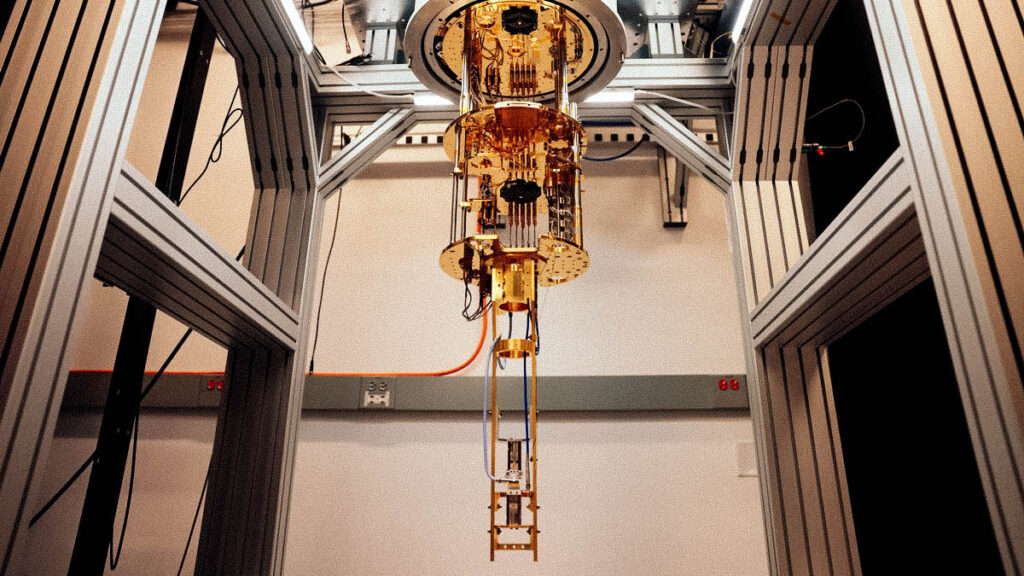
Quantum computers and artificial intelligence will augment each other in the future. Three theories by physicist Achim Kempf from the University of Waterloo in Canada reveal the potential of this synergy.
read more