
Precision medicine of the future
Researchers at the MOLIT Institute for Personalized Medicine are developing methods to analyze medical data and improve individualized cancer therapies.
read more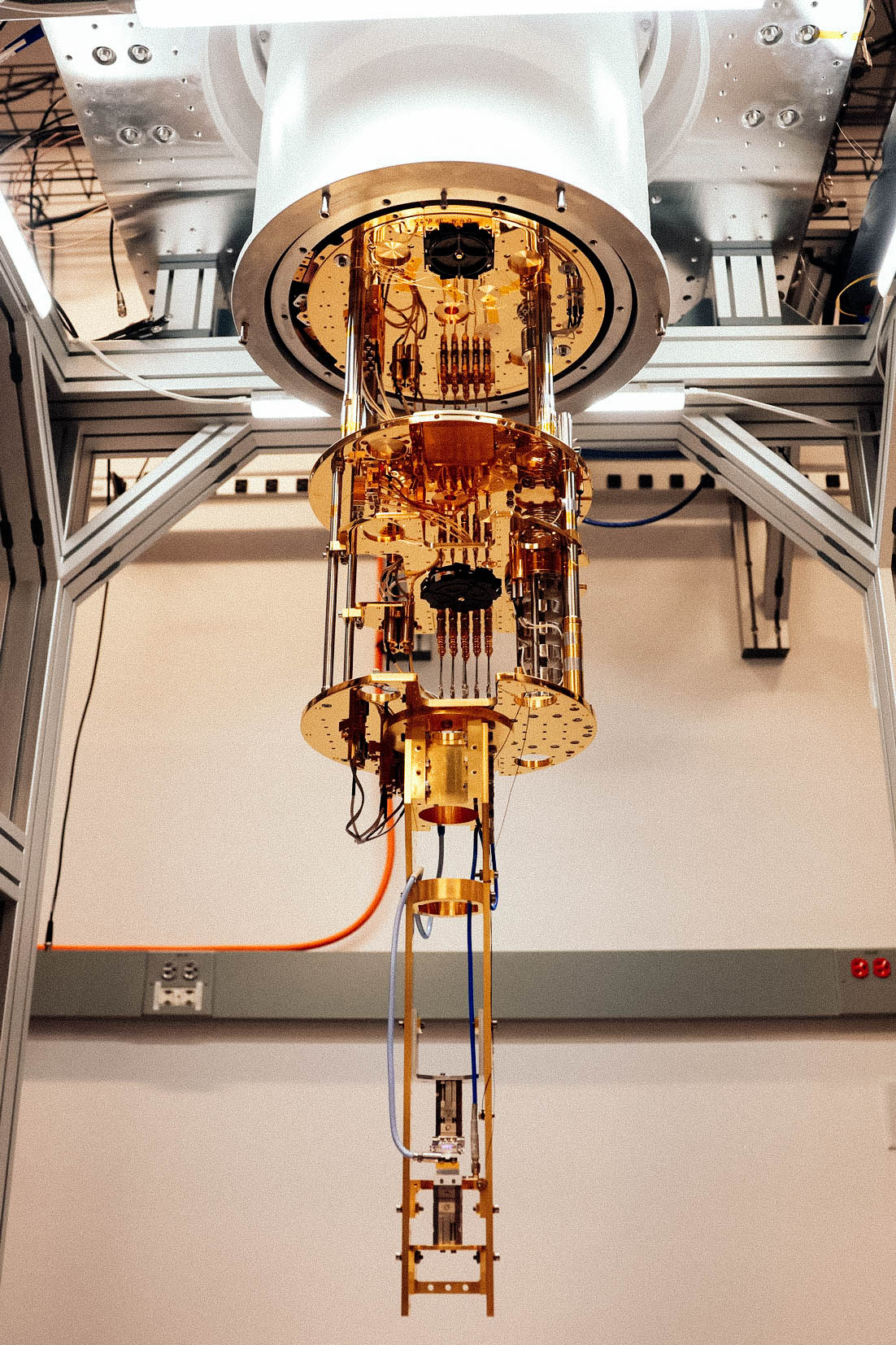
Quantum computers and artificial intelligence will augment each other in the future. Three theories by physicist Achim Kempf from the University of Waterloo in Canada reveal the potential of this synergy.
Unlike conventional computers, quantum computers do not work on the basis of bits and bytes, but with so-called qubits. These can not only represent combinations of zeros and ones, but thanks to quantum physical phenomena, they can also assume countless superposed states between zero and one. This makes them more powerful than digital computers for many computing problems and allows them to solve much more complex problems.
This opens up new possibilities in areas such as materials research and optimizing complex logistics chains – at least in theory. Quantum computers developed to date are still too small and unreliable to deliver on their huge potential. Artificial intelligence (AI) can help pave the way for practical quantum computing. But AI will also benefit from the enormous potential of the supercomputers, according to Achim Kempf from the University of Waterloo in Canada. The physicist describes how these two future technologies will support each other in three different scenarios:
Prof. Dr. Achim Kempf is Chair in the Physics of Information and AI at the University of Waterloo in Canada, which is funded by the Dieter Schwarz Foundation. His work focuses on issues relating to quantum information and artificial intelligence.

“The central challenge of quantum technology is the susceptibility to disruption of qubits, i.e., the atoms, molecules, and photons with which quantum processors work. Efficient methods for correcting errors are therefore a prerequisite for a practical quantum computer. Great progress has already been made in this area over the years, but we are not there yet. With AI, we can now develop intelligent, automated methods to correct errors and take them to a new level. Acting as a kind of intelligent autopilot, AI systems would not only compensate for errors, but in the best-case scenario even anticipate and prevent them, thereby stabilizing the highly sensitive quantum processors.
However, there is another problem to solve on the path to a practical quantum computer: we simply do not have enough software yet to operate one in a meaningful way. Although we do have the first quantum algorithms, these were developed for very specific purposes. What we lack is a library of algorithms that can be assembled like building blocks to write complex programs for different applications. AI can also support and accelerate their development.”

“Once quantum computers are finally available for practical use, AI itself will benefit from their capabilities. It can be assumed that AI models on quantum computers will require less training data and at the same time be able to deliver faster and better results than on conventional computers. This is because quantum computers are capable of performing much more complex calculations than classical computers. Once they reach a certain level of development, they should also be more energy-efficient. This would benefit the competitiveness of European AI models, which are currently at a disadvantage compared to systems from the U.S., not least because of higher electricity costs.”
The central capability of AI is to recognize patterns. Combined with the quantum computer’s complex capabilities, this opens up new possibilities in research and technology. For example, in solving complex problems of optimizing things: transportation networks, production processes, or supply chains could be improved in real time, thus making them more economical and sustainable. We also expect major advances in materials and drug research: if we can simulate the interaction of molecules or the complex structure of crystals on a quantum computer and evaluate them with AI, this will significantly accelerate the development of novel materials and drugs.
Researchers at the MOLIT Institute for Personalized Medicine are developing methods to analyze medical data and improve individualized cancer therapies.
read more
To harness the potential of high-performance computers, Hartwig Anzt from the TUM Campus Heilbronn develops and optimizes methods for solving mathematical equations. His goal: more efficient software.
read more
Arkadia, a nonprofit organization, operates a learning space in Heilbronn, Germany dedicated to dialog, experimentation, and urban development. Marianna Georgiou explains how OpenSpace works.
read more