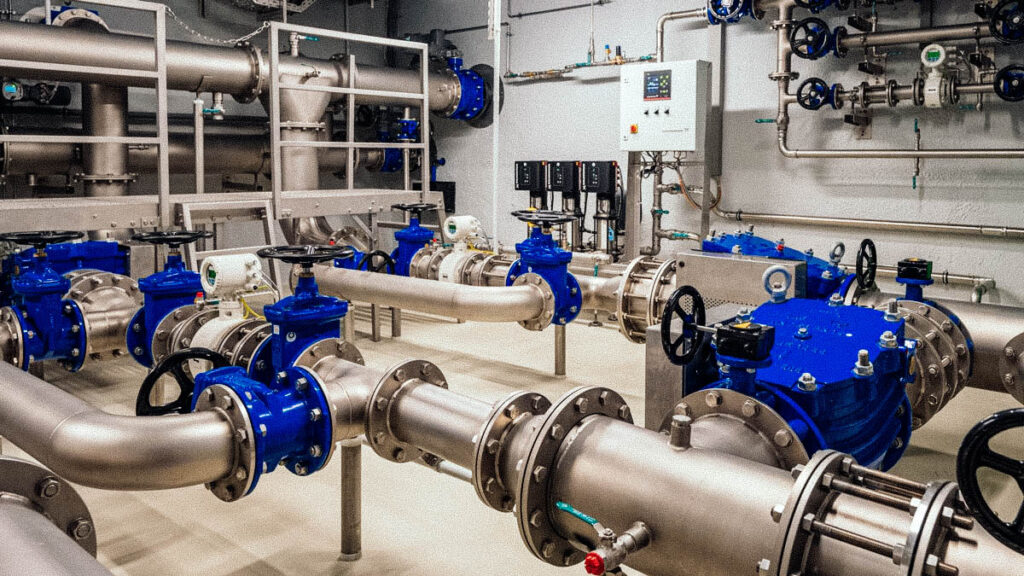
Water management 4.0
In Heilbronn, a digital twin is being tested to make the water network more efficient and secure. This saves resources and costs – and opens up new business models for companies.
read more
To harness the potential of high-performance computers, Hartwig Anzt from the TUM Campus Heilbronn develops and optimizes methods for solving mathematical equations. His goal: more efficient software.
Modern supercomputers can perform more than a trillion computing operations per second. Since 1965, when the American chemist Gordon Moore (1929–2023) quite accurately predicted that the number of transistors on computer chips would double within one to two years, computing power has increased a billionfold.
Such high-performance computers (HPC) are used, for example, to simulate flow conditions in aircraft and rocket engines or to model the development of galaxies and black holes. They train neural networks, optimize artificial intelligence algorithms and make weather forecasts more reliable.

In addition to the hardware, however, the software must also keep pace with the increasingly complex demands of research and technology. “We not only need more computing power, but also more efficient programs for the increasingly complex simulations,” says Hartwig Anzt from the TUM School of Computation, Information and Technology (CIT).
Take ICON, for example: The model for weather and climate forecasts was developed by the German Meteorological Service, the Max Planck Institute for Meteorology, the Karlsruhe Institute of Technology (KIT) along with other institutions. Among other things, it provides the data for the weather forecasts at the end of the “Tagesschau” news program.
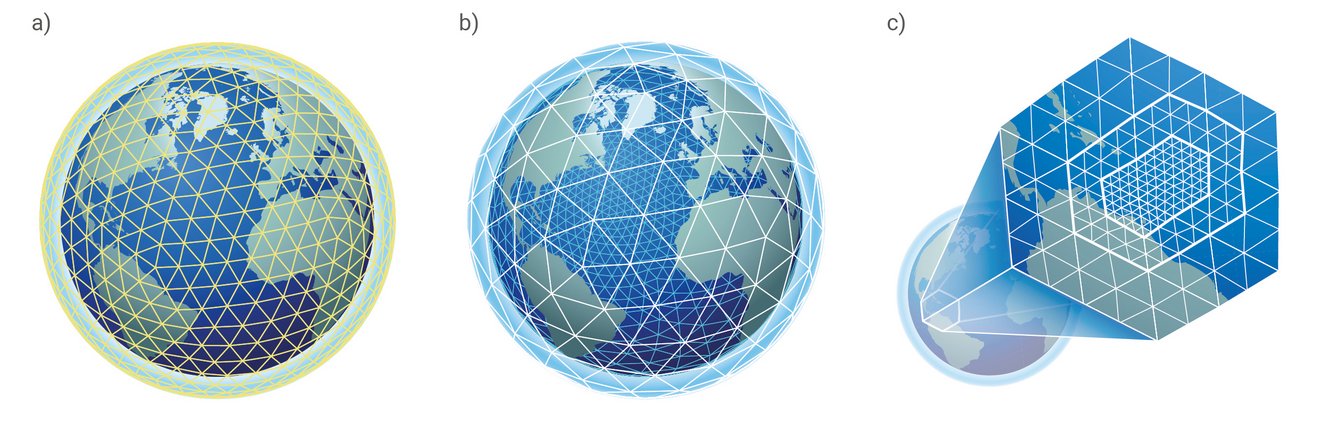
ICON calculates its forecasts of future weather developments based on a grid that maps the earth’s surface. This grid contains data such as temperature, pressure and humidity from historical and current measurements. For regions where a high forecast accuracy is required, the grid – and thus the numerical approximation – can be calculated with a very fine mesh.
However, as the spatial resolution becomes finer, the amount of data increases – and with it the computational effort. “That’s why we are focusing on speeding up the calculations,” says Hartwig Anzt. “This is important because ICON performs a large number of simulations for a single forecast, each with slightly different parameters.” According to the computer scientist, such “ensemble simulations” are complex, but reduce uncertainties in the forecasts.
At their core, computer models always involve solving linear and non-linear systems of equations. These form the basis for modeling weather patterns, just as much as they do for simulating wind turbines or jet engines. “Most of the time, it doesn’t even matter what exactly needs to be calculated,” says Hartwig Anzt, turning to one of his most important research topics: GINKGO.
The computer scientist is one of the co-developers of this software package, which provides various numerical methods for solving systems of equations. “You can think of it as a kind of toolbox that researchers can use to solve their equations.” This means that developers can streamline the programming of their software for modeling a wide range of tasks by incorporating interfaces to GINKGO, which then provides numerical methods for the systems of equations and efficiently performs the computing work.
The TUM Campus Heilbronn is part of the Technical University of Munich (TUM). It combines innovative research, talent development and social responsibility with entrepreneurial courage and works closely with the economically strong Heilbronn-Franken region, which is characterized by medium-sized enterprises, including numerous global market leaders. With a focus on management as well as computation, information and technology, the TUM Campus Heilbronn promotes the specialists of tomorrow, enables knowledge transfer and develops innovative solutions for the challenges of the digital age.
The Dieter Schwarz Stiftung initiated the establishment of the TUM Campus Heilbronn. It not only provides the infrastructure on the Heilbronn Bildungscampus, but also supports professorships, research centers and numerous initiatives, for example, in the area of digital transformation.
The team at the TUM Campus Heilbronn has set itself a particularly ambitious goal of simulating the human heart. Within the MICROCARD project of the “European High Performance Computing Joint Undertaking” (EuroHPC JU), the aim is nothing less than to create a computer model of the human heart at the cellular level. “We know that the individual heart cells communicate with each other using electrochemical processes,” says Anzt. “But we don’t yet understand exactly how this works and which anomalies lead to cardiac arrhythmias or a heart attack.”
Until now, the computing power for simulation at the cellular level was simply not sufficient, as our heart contains several billion cells. With the help of GINKGO, this should now be possible. In the future, Anzt hopes that the heart can be represented as a “digital twin.” Diagnosed cardiac arrhythmias or other symptoms of patients can then be simulated in the model – with the aim of identifying the regions in the digital heart where the electrical conduction is disrupted in the affected individuals. This means that cardiologists know at an early stage where and how to start treatment, for example, to prevent an impending heart attack.
In Heilbronn, a digital twin is being tested to make the water network more efficient and secure. This saves resources and costs – and opens up new business models for companies.
read more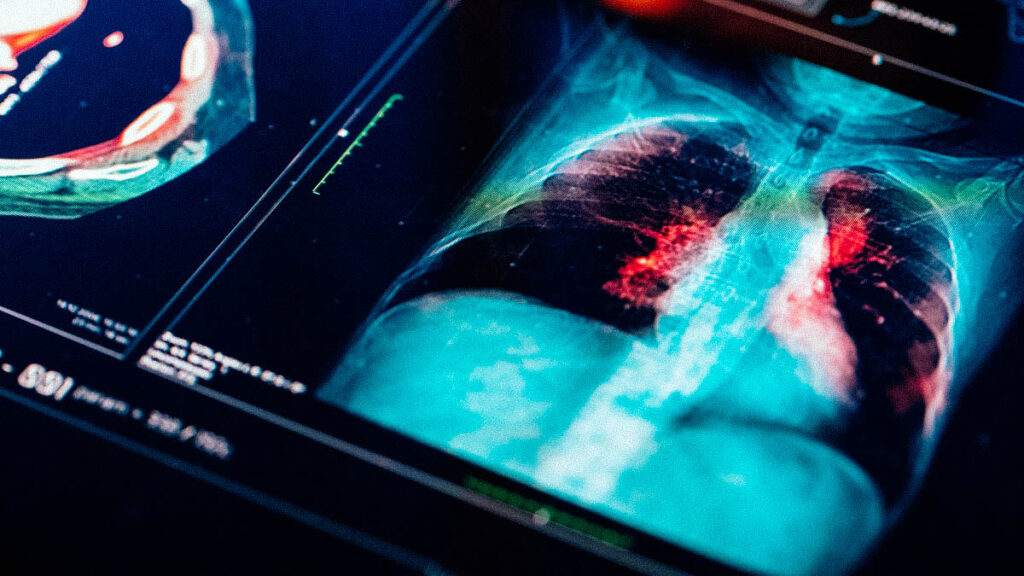
Researchers at the MOLIT Institute for Personalized Medicine are developing methods to analyze medical data and improve individualized cancer therapies.
read more
Researchers at Fraunhofer HNFIZ have developed a transformation index, based on the results of 35 years of study and research. It allows companies to assess how future-proof they are.
read more