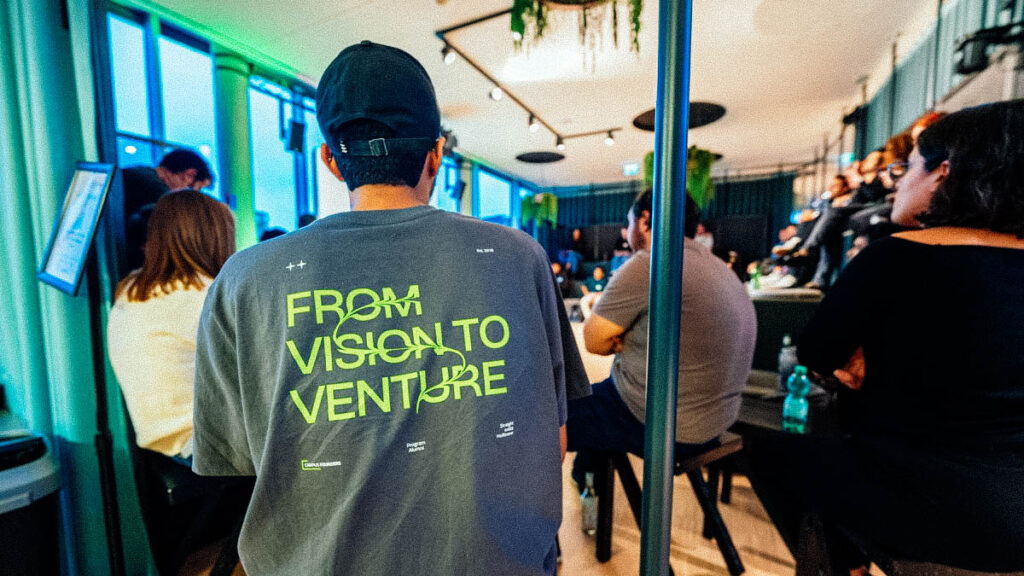
“Success attracts success”
The start-up scene thrives on new ideas – and on successful role models. Three mentors from Campus Founders describe how they support young founders with advice and practical assistance.
read more

“We need fewer regulations and more orientation,” says futurist Florence Gaub. A conversation about optimism as a learnable attitude and the opportunities for Germany and Europe in the field of artificial intelligence.
“Humans are beings who have the ability to imagine the future in such detail that they can create it.” This quote is from you. What exactly are you trying to tell us?
Florence Gaub: There are basically three ways in which people look to the future: with trepidation, with a willingness to take risks – or not at all. The latter is probably the most widespread and certainly the most problematic. Many people only think a few weeks ahead, don’t pay enough attention to their retirement planning or ignore long-term developments such as climate change. But if you don’t engage with the future, it will simply happen to you.
What I’m trying to say is that the alternative lies neither in blind risk-taking nor in a constant state of caution. Planning the future is strategically similar to a soccer match: You don’t win by playing only defensively or solely offensively. Adopting a reflective approach to risk is crucial. From an economic perspective, this is key: New things only emerge when there is opportunity to take risks without fear. Countries that approach the unknown with less fear are more innovative and economically more successful. Those who shy away from risks stifle developments, while openness to new challenges fosters growth – both economically and individually.
“The future therefore requires neither fear nor overconfidence, but rather attentiveness, strategic thinking and the willingness to take responsibility.”
Dr. Florence Gaub
That’s easier said than done, isn’t it?
Gaub: In such simplistic terms, yes. However, optimism isn’t an innate characteristic, but an attitude. It’s a trait you can acquire. Those who are primarily concerned with what’s beyond their control will develop a sense of powerlessness. However, those who think about what can be influenced in concrete terms will inevitably become more optimistic. It’s like a muscle that grows through use. Over time, a reflex develops to search for what is possible and can be created. And this gives rise to confidence.
Let’s look at this from the perspective of companies: They have to react ever more quickly and creatively to national and international developments. How can the state help them with this?
Gaub: It’s true that rules and regulations create security. In my opinion, however, we don’t have too little of this formal security in Germany, but rather too much. Our legal system creates stability. At the same time, however, companies are experiencing overregulation in many areas, which makes innovation very difficult, especially in these times.
It’s not so much a lack of security as a lack of orientation. Security doesn’t arise from someone claiming to know exactly what will happen next. It comes from a vision: Where do we want to go, and how do we get there? A vision describes the target state and the path toward it. This is also a political task.
Dr. Florence Gaub is a Franco-German political scientist, futurist and security expert. Her work focuses on geopolitical developments, strategic foresight and the question of how societies cope with uncertainty and global change. Gaub worked for many years at the European Union Institute for Security Studies and is currently director of the research division at the NATO Defense College in Rome. With books such as “Zukunft: Eine Bedienungsanleitung” [Future: An Instruction Manual] (2023) and “Szenario: Die Zukunft steht auf dem Spiel” [Scenario: The Future Is at Stake] (2025), she has made futurology accessible to a wider audience.

Can you elaborate on that?
Gaub: The state can improve the framework conditions. Ultimately, however, politics, business, science and civil society share this responsibility. It is about identifying the key challenges of the coming decades, developing long-term perspectives – and defining the necessary steps for the future in clear and concrete terms. This gives people more stability than simple promises. Our problem is not a lack of security, but rather a lack of creativity and willingness to innovate in dealing with what is to come.
What exactly does this mean for companies?
Gaub: They have a special responsibility here. They can develop precisely these visions in their respective areas, alone or in conjunction with other stakeholders. What problems will need to be solved in the next 20, 30 or 50 years? What specific steps need to be taken to address these problems?
Artificial intelligence is the central buzzword and the key technology of the future. Are we as a society and as one of the world’s largest economies prepared for a successful AI future?
Gaub: I don’t find the question of whether we are “prepared” helpful. It quickly leads to a simple yes or no answer. In my view, something else is crucial: Do we have a clear understanding of which areas of artificial intelligence we can still develop in Germany?
We are lagging behind in large generative language models and will hardly be able to catch up with American companies. But there is considerable potential in the fields of healthcare, industry and education.
Unfortunately, in Europe we are still focusing heavily on the risks presented by AI and tend to overregulate it. Of course, there are sensitive areas, such as in the military or police sector, where we have to act with caution. But at the same time, there is enormous potential in other areas.
Therefore, I would say: We are not unprepared due to a lack of ability, but because we are allowing fear dominate the debate. Instead of constantly focusing on new concerns, we need a constructive examination of the possibilities of this technology and a clear answer to the question of which areas we want to be at the forefront of. We need this vision.
“We have a solution for the vast majority of challenges that I see today. We just have to implement these solutions.”
Dr. Florence Gaub
What predominates for you personally when you look to the future of our world: resignation or confidence?
Gaub: Confidence. Not because there aren’t any problems. But because the problem usually isn’t that we lack solutions. We have a solution for the vast majority of challenges that I see today. We just have to implement these solutions. That is why I’m confident.
The start-up scene thrives on new ideas – and on successful role models. Three mentors from Campus Founders describe how they support young founders with advice and practical assistance.
read more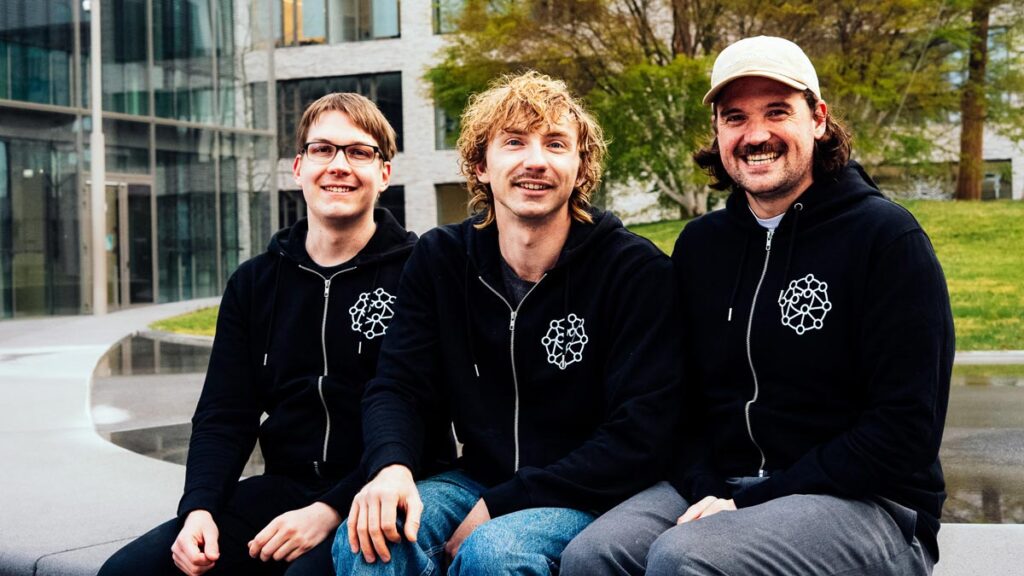
Students at DHBW have launched a start-up. Their goal: using AI to support social work organizations. Their biggest challenge: data protection.
read more
In its exhibitions, the IPAI Foundation presents artificial intelligence in a very special light. The artworks, generated in collaboration with AI, make the connection between art and technology tangible.
read more