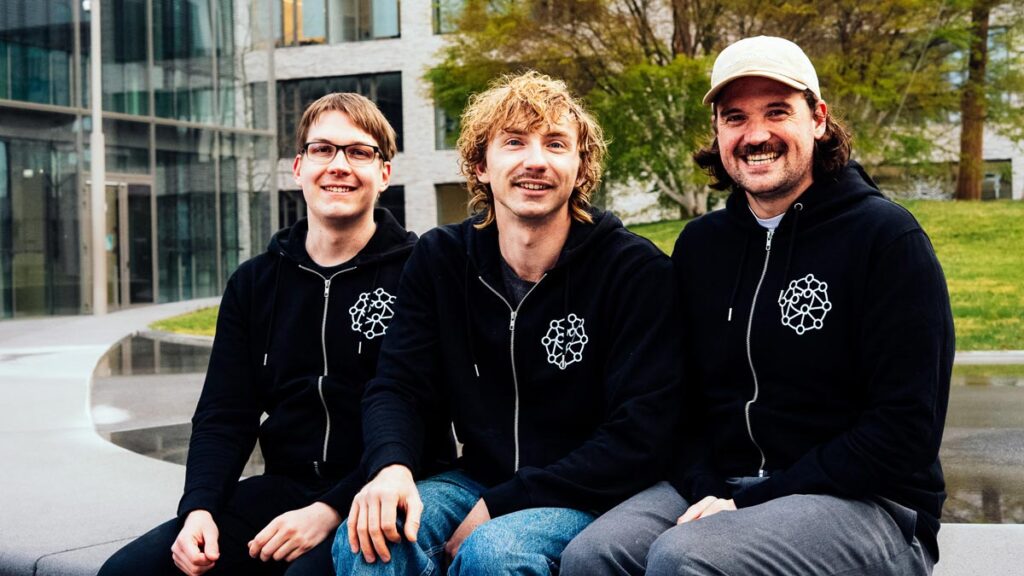
From Classroom Assignment to Start-Up
Students at DHBW have launched a start-up. Their goal: using AI to support social work organizations. Their biggest challenge: data protection.
read more
Whether a startup becomes a success depends on a variety of factors. A big-data study shows how success can be predicted—and which types of founders have a particular knack for it.
It all starts with an idea—and then a lot of things have to go right for a startup to break through. The market, the product, the timing, and various other factors determine its success. The recipe for success is complex, which is one reason why investors widely diversify their investments in such companies.
Fabian Braesemann from the Oxford Internet Institute calls this the “watering can principle”: “You invest all across the board and hope to hit the jackpot.” Often, decisions are not particularly data-driven. The economist, who holds a doctorate, wants to change this through his research. Big data and AI will help make the complex world of startups a little more predictable.
Dr. Fabian Braesemann is a lecturer in artificial intelligence (AI) and the future of work at the Oxford Internet Institute at the University of Oxford. He is also an associated researcher at the Einstein Center Digital Future in Berlin, an associate faculty member at the Complexity Science Hub in Vienna, and managing director of the startup DWG Data Science. His research uses data science and AI to analyze complex economic and social systems. Braesemann is committed to promoting complex systems thinking across politics and society. The Dieter Schwarz Foundation supports the Oxford Internet Institute, specifically funding research programs on the topics of “technology and society” and “AI, government, and policy.” It also supports the project “The Science of Startups Initiative,” which is led by Braesemann.

Braesemann shows what this looks like in a study he conducted in 2023 with international research colleagues. The team analyzed more than 20,000 startups to determine the influence personality traits have in founding teams on the success of their companies.
Fundamental insight: founders exhibit different personalities than people who are employees. They show a greater preference for new and varied experiences, enjoy starting new things, and like to be the center of attention. Plus, they usually have lots of energy.
Another finding, however, is of particular interest. “Our analysis shows that there is no such thing as a typical personality type among founders, but rather six different types,” says Braesemann. The researchers describe these types in their model, which they call “FOALED” – an acronym for “Fighters,” “Operators,” “Accomplishers,” “Leaders,” “Engineers,” and “Developers”:
Campus Founders is the startup and co-innovation hub in Heilbronn. Nine different programs support founders from initial idea development and validation to market readiness and sustainable scaling. The programs combine practical experience, advanced methods, financial startup assistance, a pool of mentors, and an international network. Campus Founders is funded by the Dieter Schwarz Foundation. The foundation provides comprehensive support for the startup culture in Heilbronn and invests in the further development of the local innovation ecosystem.
When asked which personality type most likely leads to success, the answer is: none in particular. According to Braesemann, what is more important is the number of people founding a company and the diversity of their personality traits: “Teams of founders are more likely to achieve an exit than solo entrepreneurs. It is important that people complement each other well.” A diverse team is particularly well equipped for the multifaceted tasks involved in setting up a startup.
Currently, Fabian Braesemann is collaborating with the Heilbronn-based startup and co-innovation hub, Campus Founders, to test an online tool that he and his team have developed to assist aspiring entrepreneurs in assessing their own personality in the context of founding a startup. The “Founder Personality Quiz” is designed to show them which tasks they should focus on themselves and which ones they should delegate to colleagues whose other personality types are better suited to them. Incubators could also benefit from the tool, says the researcher: “Knowing the personalities of the founders can help to provide startups with optimal support.”
In the long term, Braesemann wants to use the possibilities offered by big data and AI to create simulation models of entire startup ecosystems. This would enable evidence-based decision-making—both for policymakers, who set the framework for entrepreneurship, and for investment firms, which could use their financial resources in a more targeted fashion based on data. Models of this kind are still a long way off, but one thing is already clear from the research: the personalities of founders play a key role in the subsequent success of their companies.
Students at DHBW have launched a start-up. Their goal: using AI to support social work organizations. Their biggest challenge: data protection.
read more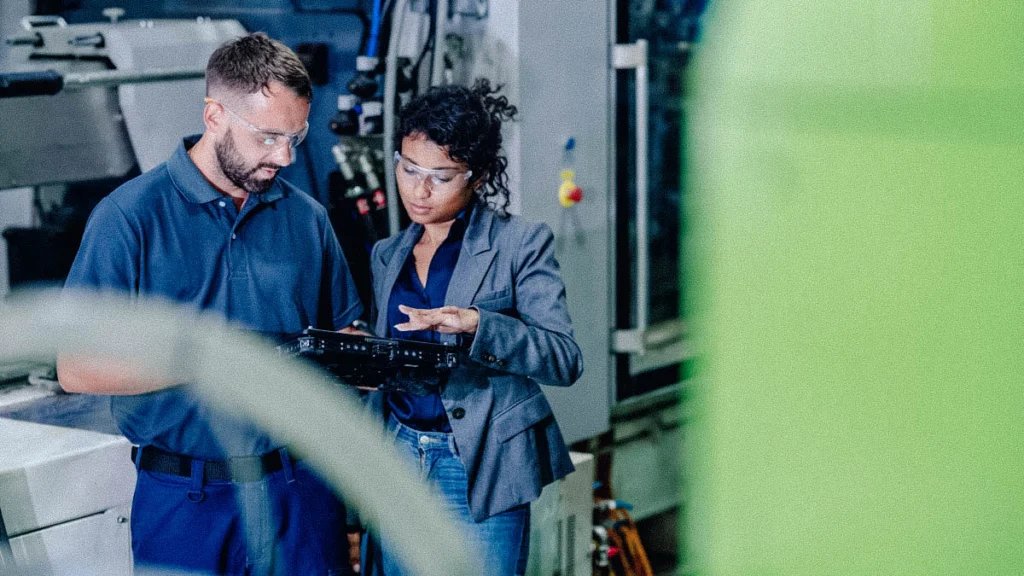
Researchers at RWTH Aachen University and TUM Campus Heilbronn have developed an online tool designed to help mechanical engineering companies offer subscription models with less risk.
read more
Five minutes on a stage could change everything: At the Heilbronn Slush’D startup festival, young startups competed for up to €100,000 in funding. The jury’s choices show that nothing gets done without AI.
read more