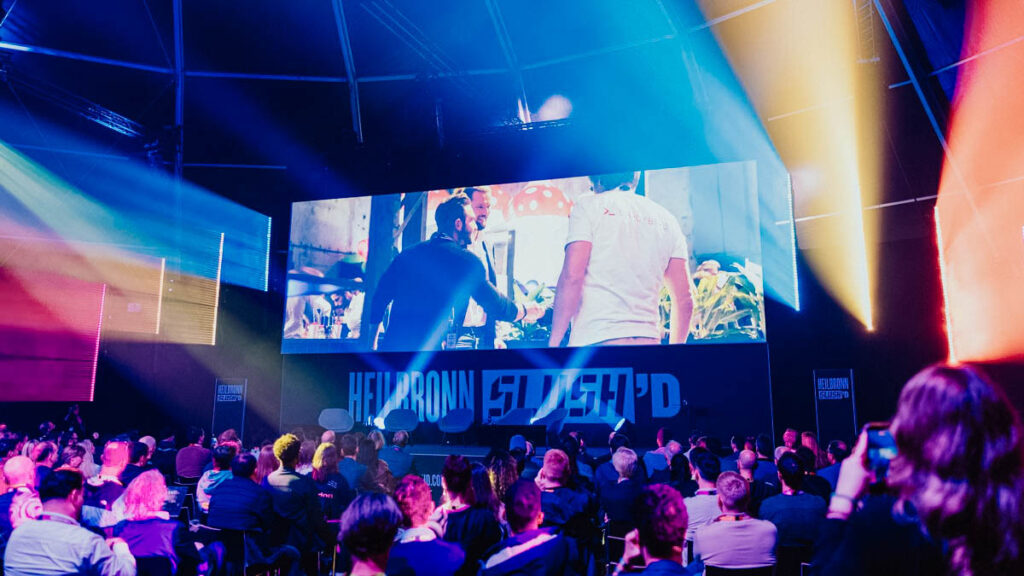
Pitched — and Winning
Five minutes on a stage could change everything: At the Heilbronn Slush’D startup festival, young startups competed for up to €100,000 in funding. The jury’s choices show that nothing gets done without AI.
read more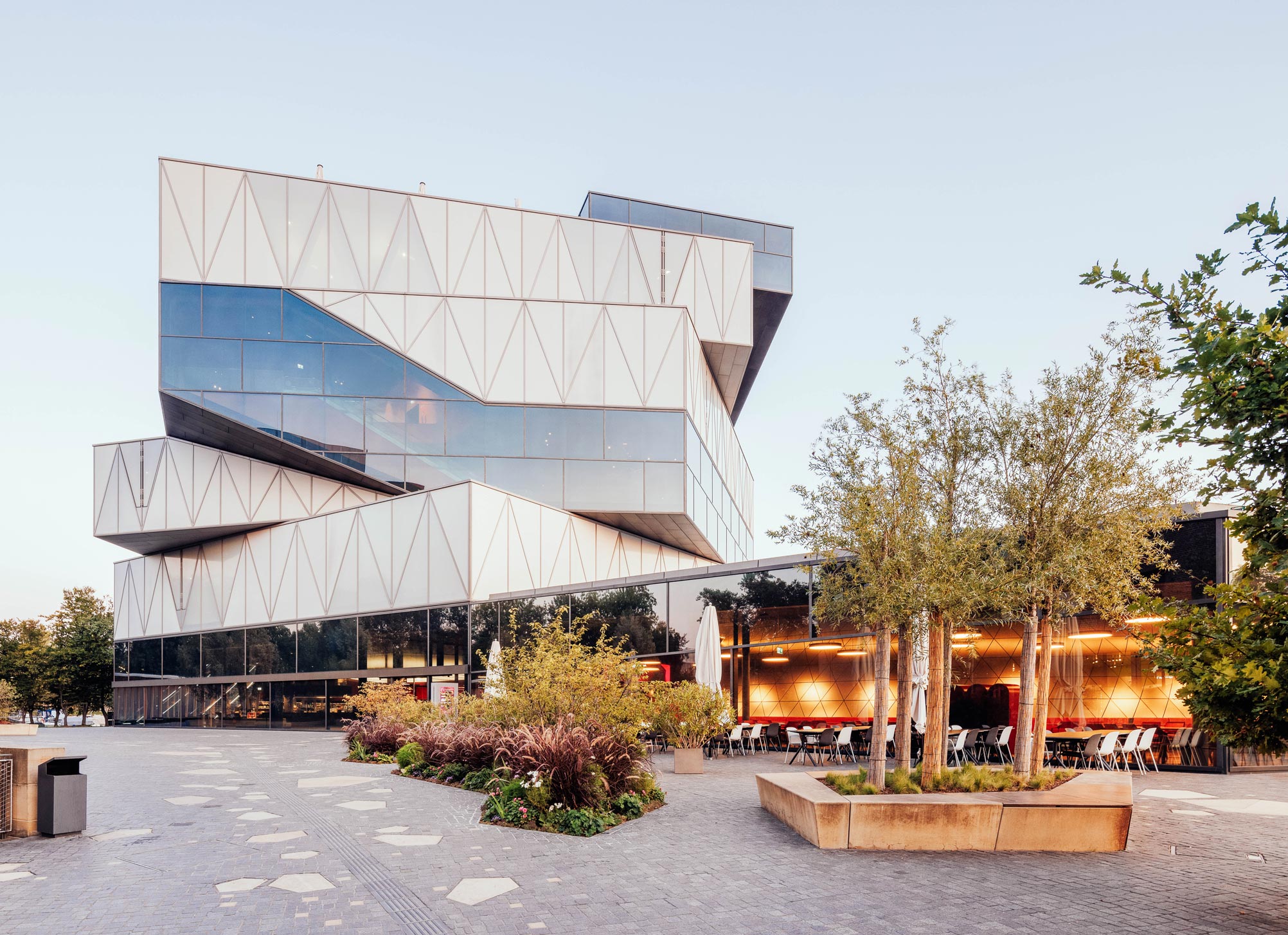
Heilbronn is rapidly transforming from an industrial city into a place committed to education, research and innovation.
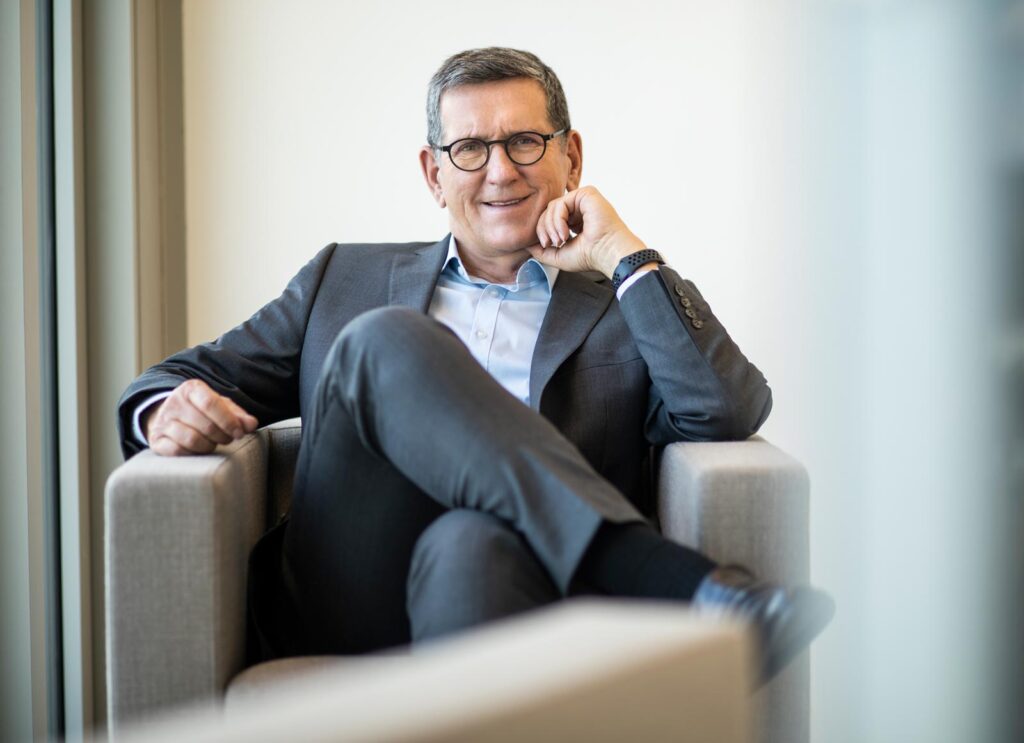
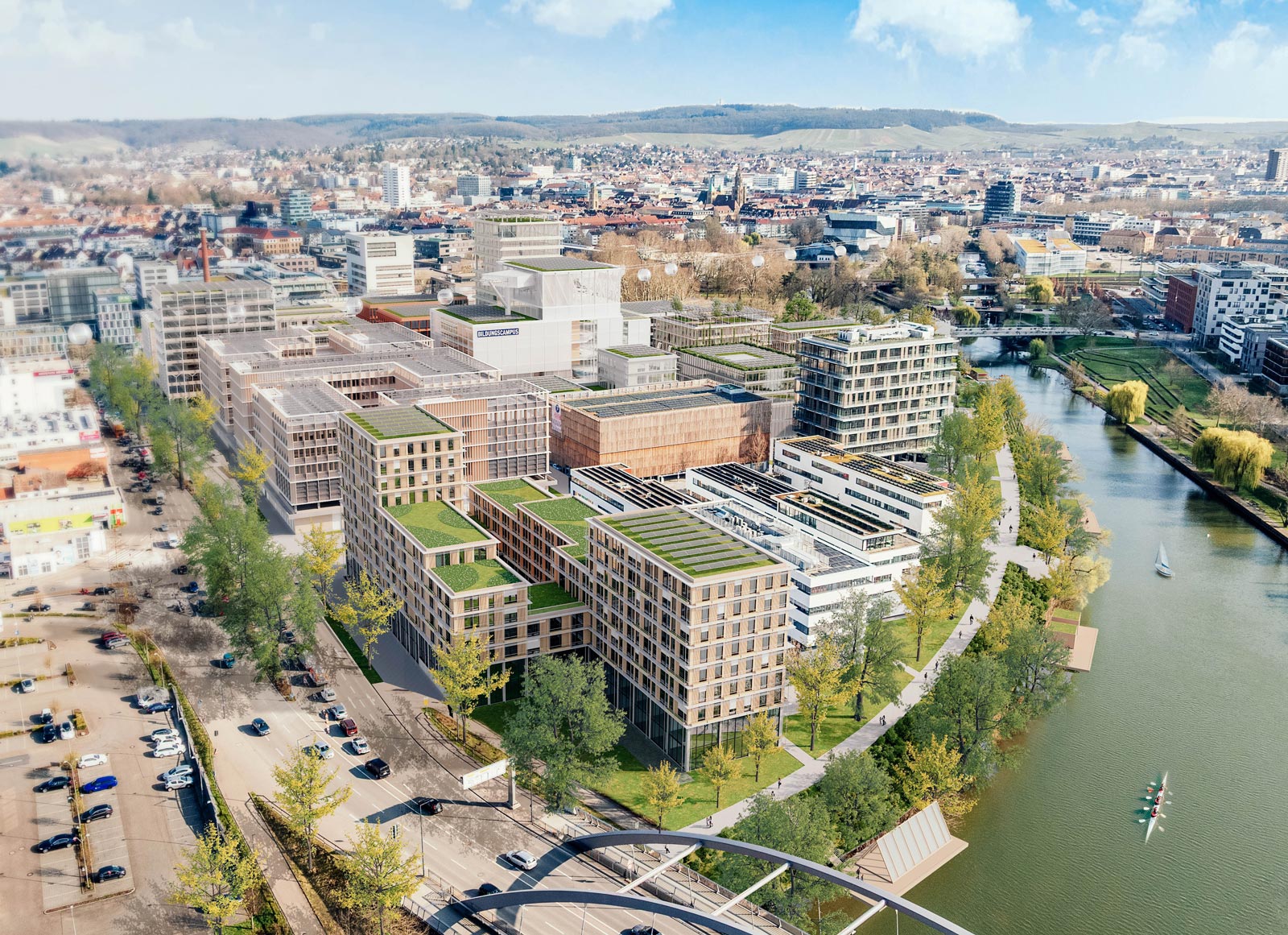
They say that if you want to shape the future, you need a vision – one that combines new ideas with courage and a willingness to take risks. In Heilbronn, they know that a vision also requires a concrete plan – one with a set timeline and clearly defined goals. Precisely such a plan lies before Reinhold Geilsdörfer on the conference table in his office. The chairman of the board of the Dieter Schwarz Foundation unfolds the plan to reveal a city in transformation. At its heart are the Bildungscampus, the Heilbronn education campus which is currently being expanded, along with the adjacent experimenta science center and the Innovation Park Artificial Intelligence (IPAI), which is under construction.
Reinhold Geilsdörfer begins to explain how the Foundation, through its support of various institutions, aims to provide people with opportunities throughout their educational journeys – i.e. to facilitate lifelong learning. Since it’s never too early to start, the Haus der Familie, a non-profit family education center, sends “baby ambassadors” to young parents to offer information and advice. The Academy for Innovative Education and Management (aim) is committed to providing language support to children in kindergartens and schools, among other things. And experimenta was conceived as a world of knowledge and experience. Opened in 2019 in a spectacular new building on Heilbronn’s Kraneninsel (Crane Island), the science center aims to make science and technology accessible and engaging for people of all ages.
Reinhold Geilsdörfer is particularly enthusiastic about the 42 Heilbronn programming school, which has been located on the Bildungscampus since 2021. The school’s concept originated in France and, unlike many other higher education institutions, relies on project-based peer learning. The students work independently on their code. In addition to a focus on programming, the study program emphasizes critical thinking, solution-oriented work and teamwork. According to Reinhold Geilsdörfer, 42 Heilbronn aligns with the Foundation’s commitment to opening up new spaces and opportunities for education.
The Dieter Schwarz Foundation’s credo of “daring to shape the future together” is based on three pillars: education and family, research and science, and business and innovation. They are viewed as interconnected elements that are of equal importance. That is why a further step in his plan, which Geilsdörfer now turns to, focuses on research institutions and universities. He mentions the Fraunhofer Research and Innovation Centers and the Max Planck Institutes, which are funded by the Foundation. Above all, however, the universities and higher education institutes have elevated Heilbronn’s educational landscape to an entirely new level. These include Heilbronn University of Applied Sciences – the largest institution of its kind in Baden-Württemberg – as well as DHBW Heilbronn, DHBW CAS and the Technical University of Munich (TUM), which has its own campus on the Heilbronn Bildungscampus.
The Foundation has endowed 41 professorships at the Technical University of Munich, 32 of which are based in Heilbronn. In 2023, a similar model was agreed upon with ETH Zurich. It receives more than 20 endowed professorships, 15 of which are in Heilbronn. “In international rankings, TUM is in 22nd place, while ETH is among the top ten in the world. “Both universities hold ‘excellence’ status,” says Reinhold Geilsdörfer with a proud smile. “We have also built up a global network. There are endowed professorships in Paris, Oxford, Waterloo, Stanford, Jerusalem and Singapore. We benefit from the exchange between the universities and our Bildungscampus. Students, doctoral candidates and professors come to Heilbronn for several months or even a few years.”
The Foundation has built a new school for the families of researchers and staff from all over the world. At the Josef-Schwarz-Schule, which is named after the founder’s father, 1,100 students in Heilbronn are currently receiving a bilingual education. “That’s the only way we can attract top international talent,” says Reinhold Geilsdörfer. “And only with experts like these can we play a competitive role in shaping artificial intelligence as the technology of the future.”
Baden-Württemberg is already home to hundreds of institutes focused on supercomputing, quantum technology, biotechnology as well as health and life sciences. The southwest is also considered the center of German AI research, with clusters of research institutions and universities. “We’re going to bring artificial intelligence into the world of business,” says Reinhold Geilsdörfer.
This is to happen not only in established companies, but also in new enterprises. That is why Campus Founders represents another stage in his plan. The startup and co-innovation hub aims to help young people become entrepreneurs. Its director, Oliver Hanisch, worked in Silicon Valley for many years. He returned to Germany in 2020 because he felt that the Foundation was serious about its idea of building an ecosystem for start-ups.
The premises of Campus Founders’ GRAVITY building, which opened in December 2025 on the Bildungscampus, boast a typical start-up style: ultra-modern, with flexible, individually adaptable workspaces. In this setting, Oliver Hanisch and his team welcome entrepreneurs, students, engineers and researchers. Through the AI Founders program, young people can live for a time in the Rosenbergquartier – a sort of shared living community for start-up founders who want to get involved in Heilbronn. They play an important role in the transfer of knowledge between the worlds of research and business.
According to Oliver Hanisch, “transfer” is a key word in Heilbronn. There is a tangible sense of openness to new things. “The city has the courage to put ideas into practice.” People are developing their own mindset – a way of thinking and acting in which the future is seen as something positive. “Making a plan for this is a truly amazing thing.”

Over the past 15 years, the Dieter Schwarz Foundation has helped transform Heilbronn, with its population of 130,000, into a major center for education and science. Every year, the Bildungscampus in the heart of the city expands with new modern buildings and facilities. The plan on Reinhold Geilsdörfer’s table is steadily growing, with a constant addition of new pages. It also includes milestones and projects for the future – such as the Innovation Park Artificial Intelligence, or IPAI for short.
When Reinhold Geilsdörfer gets up from his conference table, his office windows offer a view not only of the vineyards on the outskirts of the city but also of the Steinäcker area. It is here that the IPAI, headed by Moritz Gräter, is being built following the groundbreaking ceremony by Federal Chancellor Friedrich Merz in the fall of 2025. “It will be a special place to foster exchange between researchers and companies,” says Moritz Gräter, the IPAI executive director. Research institutes will be provided with laboratories, while small and medium-sized enterprises, global market leaders and the German AI company Aleph Alpha are set to move into new buildings.
There is a model of the IPAI in Moritz Gräter’s office. He sits down at a long wooden table next to this model to talk. Once Gräter gets going, all trace of Swabian reserve appears to evaporate. He wants to turn the IPAI into a unique European ecosystem for AI innovation: Companies, startups and representatives of public administration are to collaborate with researchers to develop new AI applications.
In addition to a focus on small and medium-sized businesses, which play a major role in the region around Stuttgart and Heilbronn, leading international companies such as Mercedes-Benz, Porsche and Würth are already IPAI partners. The network now consists of more than 100 partners and members. “To train industry-specific language models, developers need data. Our partner companies can provide this. “They then benefit from the finished model, which can be adapted for purchasing, production or sales,” explains Gräter.
Dynamism, short lines of communication and quick decisions – and, of course, a plan. What makes Heilbronn special, according to Reinhold Geilsdörfer, is its broad perspective. The strategy seamlessly links two things: the regional and the international. Both are valued equally and fostered with dialogue established between them. “Despite the changes of recent years, it is clear to all of us that we are still at the beginning and that we will not lose sight of our goal: to help shape a world in which education and knowledge are accessible to all, innovation serves the common good and collective action ensures the quality of life for future generations.”
Five minutes on a stage could change everything: At the Heilbronn Slush’D startup festival, young startups competed for up to €100,000 in funding. The jury’s choices show that nothing gets done without AI.
read more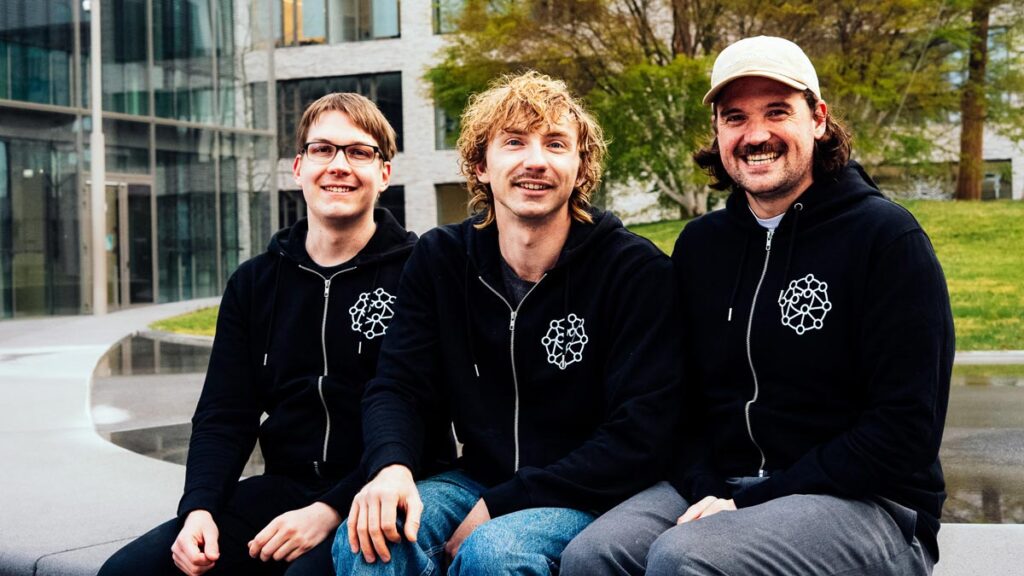
Students at DHBW have launched a start-up. Their goal: using AI to support social work organizations. Their biggest challenge: data protection.
read more
Whether a startup becomes a success depends on a variety of factors. A big-data study shows how success can be predicted—and which types of founders have a particular knack for it.
read more